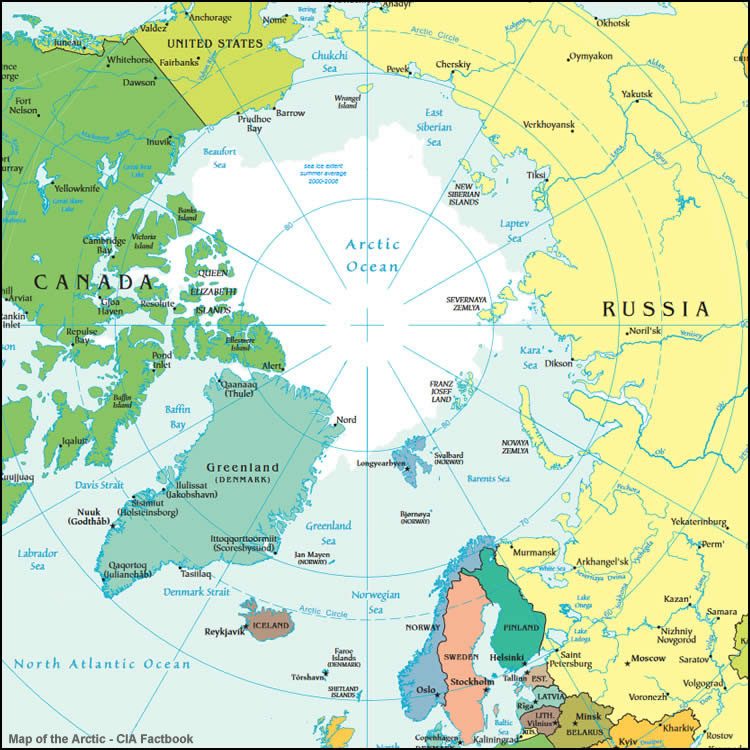
We left McGuire and flew to Goose Bay, Labrador. Then we flew up to Thule, Greenland.
It was our job to resupply various fields where people remained all winter. We had to go to Nord, Alert, and Eureka. In Thule, at this time of the year the sun is visible all night long. Outdoors all the buildings are connected by rope lines so you can find your way in a time of blowing snow. When we took off from Thule we had to worry about the weather at our destination, the weather at Thule and the weather at Sonderstom.
We had to bring a 35,000# Caterpillar tractor to Nord. The Headquarters for Military Air Transport gave a weight limit for takeoff from Thule. Nord was 765 miles from Thule. Our Alternate from Thule was Sonderstrom AFB and that was 660 miles away. With all that distance and the winds starting “white outs” at Thule and Nord, we had to cancel the delivery several times while we were airborne. Finally, we had to go to the Headquarters to allow lifting the takeoff weight to the C-130 limit.
When we got to Nord, on our third attempt, the sky below was perfectly clear and we started a penetration, went out to sea a little and turned back in to Nord. There was nothing we could see. The entire sky was covered in ice fog that was generated by our penetration. We came in at 50 feet and then thought of their large radio antennas. We held for about 30 minutes and the fog dissipated and we landed. Then we delivered the tractor.
At Eureka we went in and had lunch. The crowd was mostly Danish and we had a lot of fun with them. You can’t see Eureka on the map but you can fond Resolute. Eureka is across the bay.
It was very interesting to fly up here where the Magnetic North Pole is not really useable and we needed to use the True North Pole and Grid Navigation. It was wonderful to have a navigator to handle that, flying up there.
VR-3 wanted to have me check out as a C-130 Aircraft Commander but they did not want to have the Airlift Wing give them any grief. They arranged for the wing check airman, Commander Tufo, to give me the check ride and we left McGuire on September 23rd.
The next day we took off and headed east. Our destination was Topel. A Turkish Base where American soldiers were temporarily stationed. As we passed Athens, on our way into Turkey, they told us that the ceiling at Topel was 700 feet. It was still a bit of a flight to Topel and I said I would proceed and decide what to do when I got there.
Well, when we got up there, we spoke to planes coming out. They had stayed there overnight and they said the ceiling was 700 feet. If you look at this map you will find Yalova. That is a very small airport and I landed there several times. It had a radio navigational facility, an ADF Radio. When you wanted to make an approach to this field you could maneuver on the facility and lower yourself to 1100 feet. If you could SEE the runway from there, you could land.
Well, at 1100 feet, we would still be in the clouds. I briefed my crew. I said I would cross the ADF at 1100 feet. Then, I would fly north until we had water underneath us and I would lower myself to 500 feet. I would turn east to fly to Topelo. I said we would fly to the east end of the Sea of Marmara, cross the shore and look for the field. If we saw it, we would land and if we did not see it in three minutes after we reached the shore, we would execute a missed approach and return to Athens.
Well, that’s what we did. We saw the field, we landed, we picked up the troops and we left. I offered the check captain the leg back to Chateauroux and he said: “I’ll tell you when I want the leg.”
My copilot, Pete Simola, got really sick in Chateauroux, so I had the check pilot act as my copilot. We flew back to the States. We landed in Lages in the Azores and then went to Pope, to drop off the troops. Finally we went to McGuire. I never offered him a leg and he didn’t ask for a leg.
When we got to McGuire, he never said anything to me. It was late in the evening. My copilot and I went to the parking lot, he got in his car. It was a fancy Chevrolet that had a manual five speed transmission. He started yelling: “They’ve stolen my transmission.” So, I drove him home.
The next day, the Operations Officer called me and asked if I was qualified as an Aircraft Commander. I said: “I have no idea.” He said: “What happened.” I started to explain and he said: “Just come to my office.” So, I went into his office and explained what had happened. They called the Wing to find out what Commander Tufo had decided. They told us a letter was coming over to explain it.
Well, when the letter came the Commander opened it and read it. When they trained me as a pilot, they told me to do what I thought was the correct thing to do. That is what I did on the check ride. The Check Pilot praised me for having used the Navigation radio and adjusting the decent over water to 500 feet to enable completing the mission. He said he was pleased to elevate me to Aircraft Commander and hoped all the NEW pilots would do as well when they got checked. So, I was an Aircraft Commander.
Today, we learned that Joe Biden will be the 46th President of the United States and that pleases me because he will bring some decency to the Presidential office that has been missing through the Trump years. It will be a rough go for the next several weeks until the installation but we will deal with it.
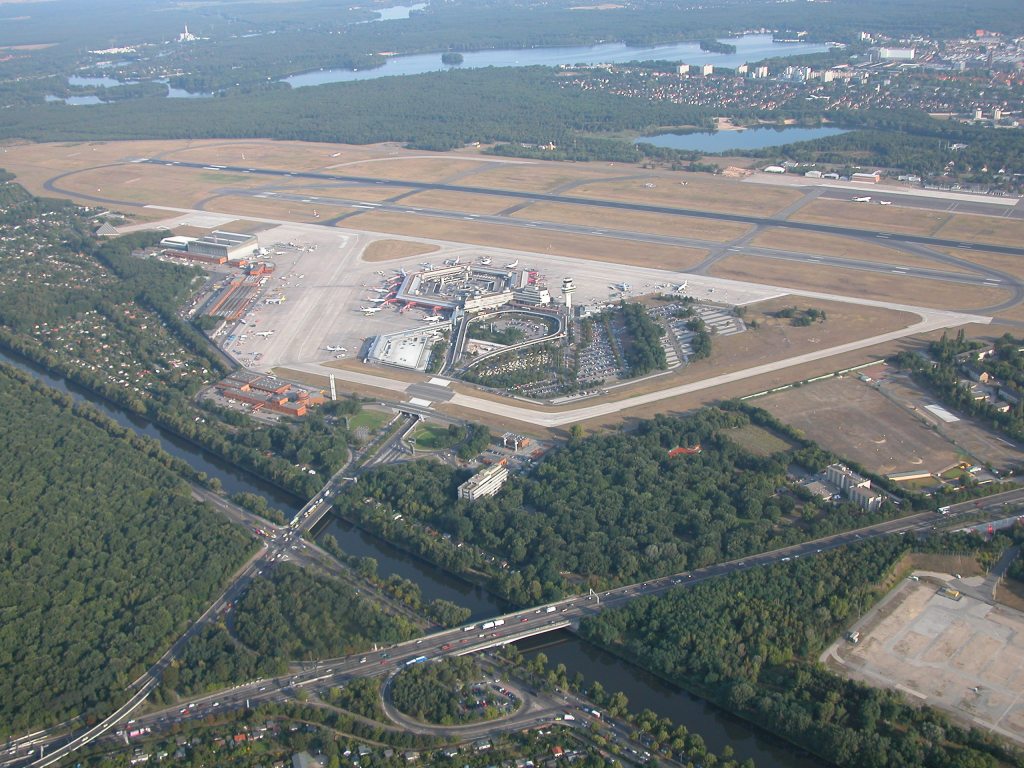
Today, we faced the closure of Tegel Airport in Berlin, Germany. Having spent a lifetime as a pilot, I have seen many airports but not one of them was better designed for passengers. The architecture of Tegel enabled cars to come inside the Hexagonal building. The design had agents at each gate to check the passenger in and the passenger walked about 50 yards to the boarding door, No long corridors full of stores selling whatever, no separate security portal, a real pleasure for the passengers.
Flughafen Tegel
Luftbilder
8. August 2003
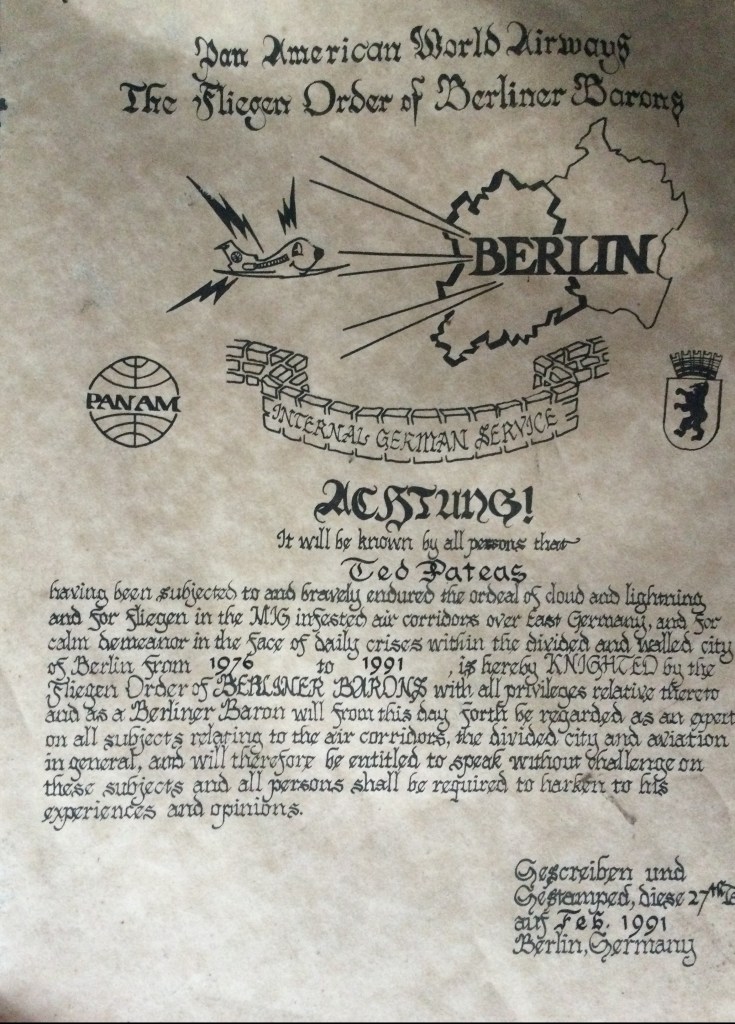
Pan Am was one of four carriers that were allowed to fly into Berlin when it was a divided city after WWII. We flew Boeing 727s and later Boeing 737s in and out of Tegel. We flew to Hamburg, Munich, Nuremberg, Frankfurt and Stuttgart for the Internal German Service, IGS and we picked up passengers in Frankfurt and London and we flew them on our aircraft to the Scandinavian countries and to all the Iron Curtain countries. We also flew to Athens,Greece and to Zurich, Switzerland and we did Charters to Italy, the Canary Islands, Dubrovnik, Yugoslavia and others I don’t remember now.
There were about 250 PanAm pilots based in Berlin. About a third of them lived in Berlin, as I did, but the others commuted back and forth to the States. The pilots that flew these routes often, in the three corridors that were agreed to during the war, would come back to Berlin at 10,000 feet, the maximum altitude the Air Force had agreed on during WWII. Then. in Berlin, we were cleared for an approach to Tegel. So, we determined which runway we were going to and how many miles we would have to fly, we would consider the wind and the local altimeter settings. Then, the pilot would decide where to pull back the thrust levers to idle, he would stay at altitude to slow down to 250 knots airspeed and then start a decent to the ILS altitude of about 2000 feet. At that altitude, he would level the aircraft and loose enough airspeed to get to his final cruising speed of 180 knots and would put out his flaps. He would hold that speed until he reached the decent beam of the ILS system and then would start desending. At seven hundred feet, he would put down the landing gear and slow to his landing speed, around 140 knots and THEN HE WOULD MOVE THE THROTTLES FOR THE FIRST TIME since he went to idle, at the top of decent.
When I joined Pan Am on February 13, 1967, I agreed to became a flight engineer because I was an Instructor Pilot and very experienced international Aircraft Commander in VR-3 and they paid flight engineers more money than co-pilots. Pan Am decided to send me to train in SFO. I went out there with my wife Joann and my daughter Alexis. We lived in Sausalito and I drove to the airport everyday.
Met a guy out there named Ray Anderson. Ray had gone to SFO State with Dan Stanland and Dan became a Navy pilot and we both served in VR-3. Dan was probably the smartest person I ever met and he was my friend. He flew a twin Beech full of top level grass from Mexico to the Utah deserts while he was a Pan Am pilot. He had some top level help from veterans.
When I got out of the Navy in December of 1966, Pan Am said they were going to send me to SFO for my training. Dan told me to look up his old friend Ray. Ray was a collector of records and had a massive collection in 1967 when I was out there. In June of that year, Bill Graham started to have a show every night in the Filmore and I helped Ray set up his projectors. We were in the balcony and Ray put on his light show: The Holy See.
The orchestra was empty and they had punch with acid and punch without acid on the stage. In 1967 acid was a legal substance. The Hell’s Angels did the security. Ray had a son named Randy. He was about 10 and by the time the music got to rocking, he would go to sleep under the tables holding the projectors. Having recently gotten out of the Navy, carrying kids to Vietnam and bodies back home in the C 130, I thought Randy could go to sleep in a fire fight.
I was at the Filmore for Janus Joplin with Big Brother and the Holding company and Jefferson Airplane with Grace Slick singing White Rabbit. That was a hell of a way to get through Pan Am training. San Francisco in 1967 was the place where kids came with flowers in their hair and I did my first hit of Owsley Sunshine.
140 Thousand years of foraging gave Homo sapiens some religious concepts. In the Altamura Cave in Spain, we have found paintings from 35,600 years ago.
In the Serra da Capivara National Park in Brazil, there are paintings that show human figures and animals in complex scenarios. These paintings show supernatural beings , hunting, dancing, sexual activity and battle. They depicted animals common to the forest area of the region. The dates of these paintings is in dispute because of the concepts about how soon Homo sapiens got to the Americas.
17,000 year old paintings have been located in the Lascaux Caves in south western France. One of the bulls is 17 feet in length.
Gobekli Tepe, in eastern Turkey, has two sets of art dating to 10,000 – 8,000 years before Christ. In the pre-pottery neolithic A art, 20 circles of 200 megaliths, up to 20 feet tall and weighing up to ten tons, were lifted and fitted into bedrock sockets. These are the earliest megaliths we know about.
In the pre-pottery neolithic B era smaller pillars were erected in rectangular rooms standing on a limestone floor.
These early structures existed before Homo sapiens learned to make pottery and pre dated the start of agriculture. It seems these structures were of importance to the foragers who lived in villages somewhere near this site at least part of the year. Archeologists assume it took 500 people to carve out these pillars and move them from the quarry to the site. By 8.000 BCE the site no longer had relevance to the new residences but they didn’t”t just abandon it to the weather but covered it over with refuse and dirt creating the tell that now exists.
The archeologists assume it was a central location for a cult of the dead and the animals carved on the pillars were there to protect the dead. It seems that the “temple was built before cities were built”. This site is within 20 miles (30 K) of Karaca Dag, where modern wheat was first domesticated.
SUMER
275 miles to the east of Gobekli Tepe, the society we know as Sumer arose. This civilization began between 4500 – 4000 BCE. They kept their cosmology and mythology alive with aural transmission until the earliest historical records, dating to 2900 BC. The first leaders of Sumer were priests and religious figures and they lived in temples. They mediated with the gods and helped society develop it’s agriculture with irrigation.
This land between the TigrIs and Euphrates rivers is very dry and dusty and as agriculture got started, irrigation was necessary for it’s success.
The Sumerian creation myth believed the universe had come into being through a series of cosmic births. Nammu, the primeval waters, gave birth to Ki, the earth and An, the sky. They mated and Ki produced a son, Enlil, who was the god of air, winds and storms. He separated An and Ki, and carried of the earth as his domain.
An carried off the sky. Nammu and An produced a son Enki, who was the god of water, knowledge, mischief, crafts and creation.
Enki had a consort Ninhursag, the lady of the mountain, she was the mother goddess and made humans from lumps of clay.
They believed in 3 (7) domes in the sky covering a flat earth. These domes were heaven and reserved only for the gods. When a person died, their souls went to Kur, a dark shadowy underworld place, located deep below the earth’s surface. Here the inhabitants were believed to lead a shadowy version of life on earth. All souls went to Kur, and a person”s actions in life had no relationship to their afterlife. These souls ate nothing but dry dust and the family members poured water to the dead through clay pipes. The style of the burial took on some significance in these later years, when those well buried fared better in the afterlife and those poorly buried, haunted the living.
All of Sumer’s religion got extrapolated throughout Mesopotamia, among the Akkadians, to their north, through Assyria to the north west and later through Babylon. The female goddesses got new names, but they always had to do with the essence of mother, and sexuality.
It is possible that the Sumerians had lived along the east coast of the Persian Gulf before it was flooded at the end of the ice age. Their story of the flood seems to have been transmitted to the early parts of the Hebrew Bible.
Two thousand years after Sumer arose, around 2500 BC the temples were replaced as the cultural centers and palaces were built for their military kings, Lu-gals (“man”+ “big”). In Sumer these kings had to intercede with the gods to deliver benefits to the people.
An epic poem called Gilgamesh was written about a likely Lu-gal of Uruk between 2800 and 2500 BC. He was a brutal and oppressive ruler who made his subjects work in forced labor or sexually abused them. An creates a wild man Enkidu. After a prostitute, Shamhat, tames Enkidu, he goes to Uruk to confront Gilgamesh. They fight, but in the end they become friends and travel together all over Sumer.
They cross to the Cedar Forest, guarded by Humbaba. Gilgamesh prays to Shamash, a female goddess, who blows wind into Humbaba’s eyes. He begs for his life, but Gilgamesh kills him.
Gilgamesh comes back to Urdu and Ishtar, a female goddess, asks him to be her consort but Gilgamesh refuses. Ishtar asks An, her father, for the Bull of Heaven which she sends to kill Gilgamesh. Enkidu and Gilgamesh kill the Bull and celebrate but Ishtar is furious and demands one of them must die.
When Enkidu dies from a disease sent by the gods, Gilgamesh becomes afraid of his mortality and sets out to find Utnapishtim, the sole survivor of the flood and who is immortal. He travels over great distances and in the end he realizes that he has failed and cannot become immortal.
These tales must have travelled to Ancient Greece, for there are similarities in the Iliad and the Odyssey of Homer that mirror Gilgamesh’s story.
PERSIA
Between 1500 and 1200 BC, the prophet Zoroaster is regarded as the founder of the Zoroastrianism, which is the worlds first monotheistic faith. He was born in northeastern Iran or southwestern Afghanistan. His tribe must have had a polytheistic culture similar to early Hinduism.
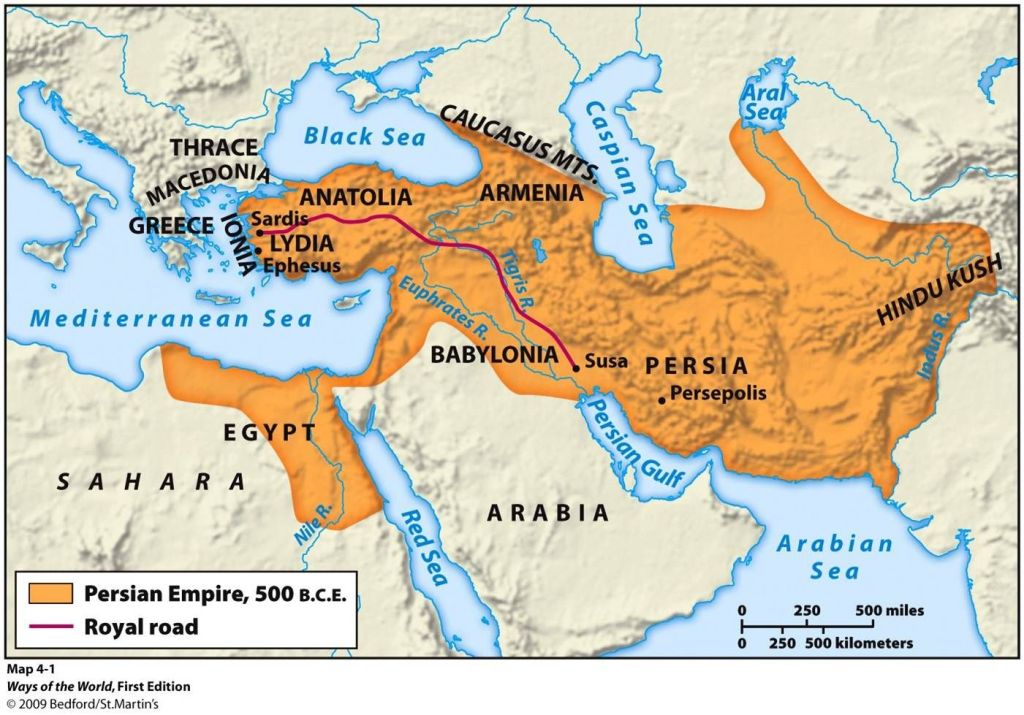
A look at the map shows the Persians spread the Zaroastrian religion over Asia from the Indus Valley, in India and Pakistan, across Afghanistan, all of Iran and Mesopotamia, across Turkey, to the Aegean Sea, up into Bulgaria and Romania, across Jordan, Palestine and Israel, in Africa, to the west as far as Benghazi, in Libya and up the Nile as far as Khartoum in the Sudan. Persepolis ruled over 50 million people, 44% of the worlds population. The Persian leaders did not force their religion on their subjects but they celebrated it themselves.
EGYPT
The Nile Valley was long used by the Homo Sapiens who left Africa on their way to Europe and the Far East. At the end of the Stone Age, there had been some semi nomadic people, who had started cultivating grain and domesticating animals. Archaeologists found some of their settlements, on the east side of the Nile. near Bandary.
The religion of Neolithic and predynastic Egypt appears to have been animistic nature worship, with each village or town with its own spirit in the form of an animal, bird, reptile, tree, plant or object. The spirit was always in something that played a prominent part in the life of the people of that locality. The spirits fell into two general groups – that which was friendly and helpful, such as cattle or hawks or baboons, or that which was menacing and powerful such as the crocodile, the hippopotamus or snakes. In both cases, the favour of the spirit had to be solicited with a set formula of words and action, and they had to have houses built for them and offerings made to them.
The original inhabitants, 5000-4400 BC, are called, the Badarians. In their cemeteries they buried the dead lying on their left sides, in a fetal position facing the west, covered in a matting. They had fine materials with them, beautiful ceramics, decorated plates and bowls, cosmetic utensils including makeup palettes, decorative combs, female goddesses made of ivory or clay. They had a myriad of naturalistic gods and idols.
The Badarians were overrun by the Amaratians (Naquadi I), who took over the area between 4500-3100 BC and they are credited as being the first Egyptians. They really started to cultivate the fertile land near the river and hunted for meat. They lived in villages and each village had it”s own animal deity which was identified with a clan emblem. From this came the Egyptian nomes with their own totems – the gods of the dynastic pantheon.
HIERAKONPOLIS …. NEKHEN
Here is where the first kings arose in ancient Egypt. These people seemed to wage a battle to control Chaos (ISFT) and tried to bring Order (Maat). This region was first settled about 4500 BCE.
The religion was interwoven into not only the ruling power, but into life itself. The deity of the town was who the people turned to, through the government, to prevent the everyday hazards of living – magic, spells, charms, folklore and amulets. They appealed to the deity for protection against hazards and to intercede on their behalf for anything from the Nile flooding to sowing and harvest to protection from poisonous animals to childbirth.
As the spirits became gods, in each town or village, the deity had its own temple staffed by priests, who dealt with the deity’s daily wants. In return for these services, the god was thought to protect its people, ensuring fertility and well-being. But if the needs weren’t met, the deity might call down wrath on the community in the form of plague or famine or other such natural disasters.
The totemic origin of the Egyptian religion is that of great antiquity. From spirits worshiped through animals, plants and even mountains to being the standard of the town itself, then to being the god of the town. The standard of the nome clearly showed which deity protected the town. And, as the town gained prominence, so too did the town’s standard.
The Amaratian art improved and they made pottery with animals and human figures hunting or praying. The first signs of papyrus bundle boats appeared. The female goddess appeared in multiple settings and bearded male figures were carved into “magic wands”.
Their graves held statuettes to keep them company in the afterlife. The dead were buried with food, weapons, amulets, ornaments, decorated vases and palettes.
By 3500BC, the Naqada II people superceded the Naqadan I. They had mastered the art of agriculture and had begun the use of man made irrigation. They no longer had to hunt for food and they started to live in towns, with a higher density of population than had existed in the villages.
These Gerzean people expanded the artwork that was done, new styles of pottery and copper metalwork was done and they used copper knives.
They traded with far distant peoples for copper and other goods (they traded much further than the previous two cultures) – silver, lapis lazuli, lead, cylinder seals were some goods traded for from Asia and Mesopotamia. Foreign influences through their trading began to show in their style of dress, ornaments and various implements. Radical changes in the design of knives, daggers and pottery were made by the Gerzeans.
They created cast-metal implements and weapons. They created a wide array of animal shaped ceremonial palettes and some shield shaped palettes that were the predecessors of the ceremonial palettes that were used in Dynastic Egypt. They created the images and totems of the Falcon, symbol of the Sun god Ra, and the cow, symbol of the love goddess Hathor.
The graves they created were larger, the dead were not buried in any particular orientation and there was some sign of ritual due to shattered pottery in the graves. The grave goods gave archeologists the sense that classes of people seem to have arisen by this time.
There was a Zoo in NEKHEM about 3400 BCE. The first rulers caught and captured animals that represented Chaos and animals that represented Order. They held them captive and demonstrated the rulers power to preserve order. They were killed when the ruler died. The first animal unearthed was a baboon. They found Hippopotamus and Crocodile and Elephants buried here. This occurred for several generations but later, they created a barricade and gathered the animals and paraded them and ritually killed them to feed the people in the center of Nekhem.
A ritual palace temple with postholes big enough for tree trunks was found in Nekhem, the cult center for Horus of Nekhem. It had a large oval courtyard, surrounded by various buildings and is the forerunner of the royal ritual precincts of the early Dynastic period. This is the root of Egyptian kingship.
The Naqada III had many territorial divisions, known as nomes. They had their own sacred animal or plant that became the totem, fetish or emblem of that territory. This fetish was depicted on the pottery of that nome. These nomes resulted in two states Upper and Lower Egypt. Each state had its own king. Later the Pharos unified Egypt into a national state. In Egypt the Pharaoh was the direct dispenser of all good fortune in the country.
Horus and Nekhbet, the vulture goddess of Al Kab, came to represent Upper Egypt. In Lower Egypt, Set and Udjo, the cobra goddess of Buto, were worshiped. In later Egyptian history, the vulture and cobra were united in the royal diadem, to represent dominion over both lands. So when Nekhem became the most powerful town, Horus became the god par excellence. The rulers started to identify themselves as the living embodiment of the hawk god.
The growth of the Egyptian religion is one of the reasons why Egypt ended up with such a complex and polythestic religious system. When a town grew in prominence, so did the god. When the town was deserted, the god disappeared. Only a few of the many deities ended up in the Egyptian pantheon, and even then their popularity waxed and waned through the thousands of years of Egyptian history. Another reason for complexity was when people moved, their god did, too. This meant that at the new town, there was sometimes a battle between the old and new gods – but the Egyptian gods were easily merged, with other gods taking over that god’s attributes and abilities! So it is that some of the ancient gods of Neolithic and Predynastic Egypt came to national prominence are considered to be some of the main gods in the Egyptian pantheon today: Amun of Thebes, Ptah of Hikuptah (Memphis), Horus (the Elder) of Nekhem, Set of Tukh (Ombos), Ra of Iunu (Heliopolis), Min of Gebtu (Koptos), Hathor of Dendra and Osiris of Abydos.
This situation remained through many centuries until some Egyptians became Christians and later the bulk of Egypt became Moslem.
Ancient Greece
In order to understand what happened in Greece from the Stone Age through to the palaces of the Minoans and the Mycenaeans you will have to do some research on your own, because I can’t do all of that here. A very good starting point is: http://www.dartmouth.edu/~prehistory/aegean/
For early humans living in Europe 35,000 years ago, the climate must have presented extreme hardship and been quite terrifying. Within a few years their climate transformed from one very much like our own to one more like Siberia, with brutally cold winters that eventually lasted through spring and summer. Freezing temperatures prevailed with very little respite. For years, endless snow and ice simply accumulated and deepened, covering Europe with glaciers, forcing many humans to flee, die out, and, thankfully for us, some to adapt. About 20,000 BCE the landscape was glacier-dominated. A mile-high polar ice cap enshrouded Scandinavia and most of northern Europe. Elsewhere harsh conditions favored grassland that provided fodder for large grazing mammals such as mammoth, bison, aurochs, horses, reindeer and elk. As the ice age started to fade, from glacial maximum about 20,000 years ago, the sea level has risen by more than 125 metres (410 ft), with rates varying from less than a mm/year to 40+ mm/year, as a result of melting ice sheets over Canada and Eurasia. Rapid disintegration of ice sheets led to so called ‘meltwater pulses’, periods during which sea level rose rapidly and there was a massive flood in the Persian sea. The rate of rise started to slow down about 8,200 years before present; the sea level was almost constant in the last 2,500 years, before the recent rising trend that started at the end of the 19th century or in the beginning of the 20th.
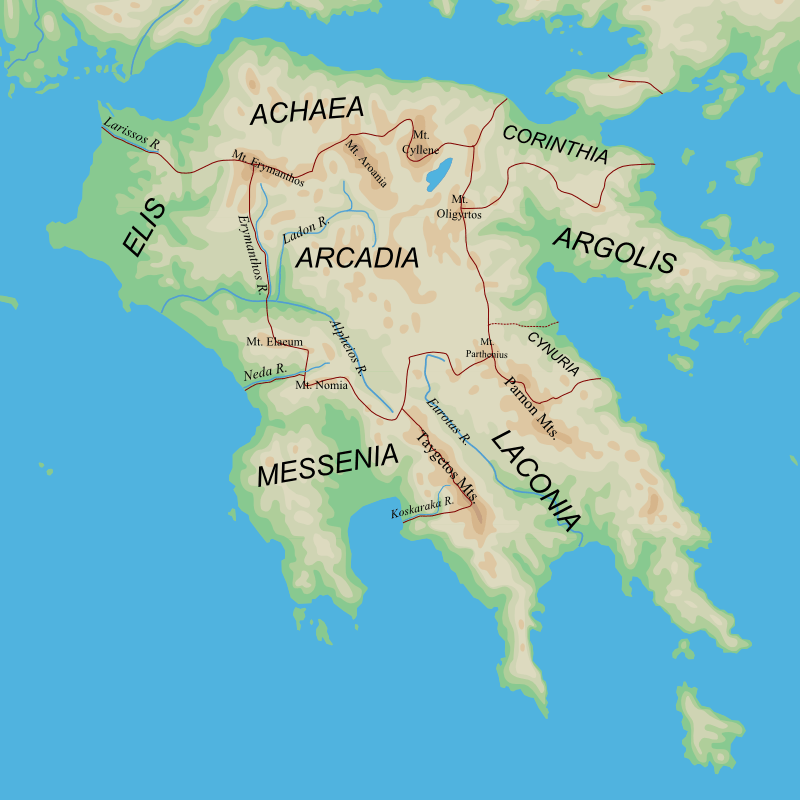
Agriculture got started in Asia Minor. This start of agriculture came to Greece by migration of Greek speaking people. There were several tribes that entered Greece. The four major tribes described by the Classical Greeks were: the Achaeans, who inhabited the Argolis and Laconia in the Peloponnese, the Aeolians, who lived in Thessaly, the Ionians , who lived in Achaea and Laconia, in the Peloponnese and the Dorians, who lived in Epirus. The Dorians came down into the Peloponnese and drove out the Achaeans from the Argolis and Laconia. They went up to Achaea and the Ionians moved toward Attica and lived there and on many Aegean islands.
In the eastern section of the Peloponnese, there is the Franchthi Cave, near the village of Kolias. Human habitation for this cave exists from 20,000 BC to 3,000 BC. These inhabitants were seasonal hunter gatherers. There is no sign of plant food before 11,000 BC.
The Franchthi Cave is below the S in ARGOULIS.
At any rate, the years rolled by and we got to Neolithic Greece. This period, from 7000 BC saw the spread of agriculture in Greece. You can get some details here: https://en.wikipedia.org/wiki/Neolithic_Greece
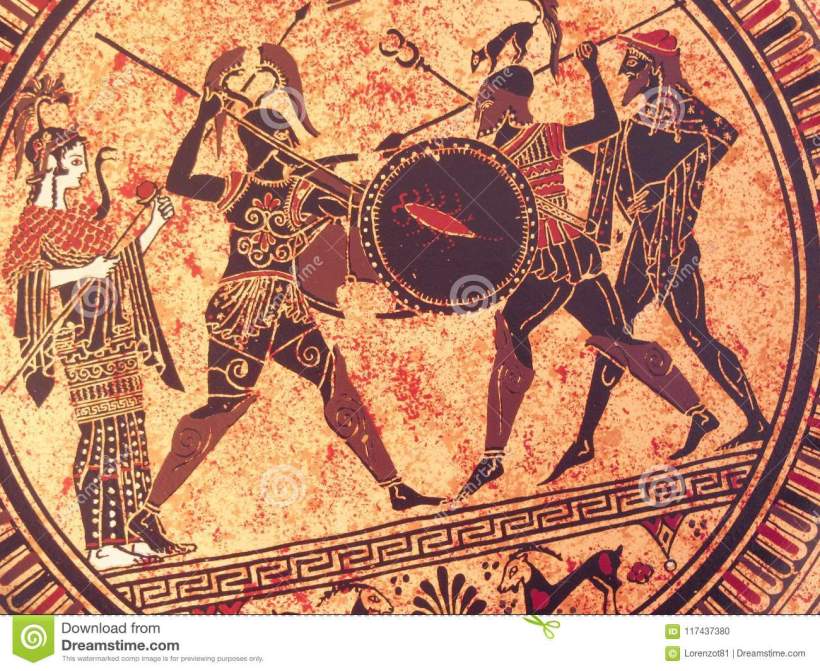
These Greek speaking tribes developed the Greek religion and it lasted for more than 1000 years. The Gods were anthropomorphic. They were the highest class of individuals and they lived forever. They had specific areas they controlled and they got involved in Human endeavors. They favored one side or another and they had a great deal to do on how things turned out. There was no church, just altars for the individual god. There was no holy book, like the Bible. People learned about this religion through the poems of the Iliad and the Odyssey from Homer and from Hesiod’s book, Theogony.
So these Gods led the Ionians who settled in Athens and the Aegean islands to a love for philosophy and rational thought that led to great public education in Greece and the rest of the world.
The Dorians were militaristic and that led to wars in Greece.
Abraham
The Biblical patriarchs began with Adam and has 20 patriarchs who led to Abram, later called Abraham, then his son Isaac and Isaac’s son Jacob, also known as Israel, the ancestor of the Israelites. The first ten patriarchs existed before the flood.
By the 21st century, archeologists have given up hope of recovering any contexts that would make Abraham, Isaac or Jacob credible historical figures. The Bible places their existence to the 2nd millennial BCE, but scholars have determined that the biblical texts were to Iron Age creations.
Judaism
The Babylonians and Egypt fought back and forth for about 25 years around 609 BCE. There were 4 deportations of people from Jerusalem sent to Babylon. During this period, the Torah was written and scribes and sages arose in power. This was a shift in Jewish religion away from the tribal temple and into the familial service described by the Torah. Only the tribe of Levi returned to temple worship after the return.
In 539 BCE, the Persian emperor Cyrus decreed that the Jews could return to Jerusalem. The story of Abraham was probably written at this time. In the Jewish tradition, Abraham was the most obedient server of God. The Jews who continued to live in Jerusalem during the exodus claimed Abraham as their father and those returning claimed that the Exodus was the start of the national Jewish religion, based on the Torah.
Christianity
Meanwhile, the Christians claimed Abraham was a “Friend of God” because of his faith in God’s good will. He is celebrated by all Christian churches, but the essence of Christianity is Jesus, the son of God. I assume you know his story.
Islam
Islam regards Abraham as one of the prophets in the link between Adam and Muhammad. They see his life as a testament to the oneness of God. They see him as a hanif, a monotheist and as a muslim, one who submits. They see him as a reformer of the Kaabe in his life.
Chemistry got started and Single cell organisms formed 3.8 BYA on Earth. That was the beginning of Biology. A billion years later, 2.8 BYA, multicellular organisms formed and life arrived. , A tree of life from common origins:
You can spend a lifetime examining the development of life on Earth. You can do that on your own, if you like, but I will move on and I’ll start talking about the Fictions that Homo sapiens created and how these fictions shaped and are shaping the world we live in.
FICTIONS
Homo Sapiens:
For the first hundred and forty thousand years HomoSapiens were foragers and they knew home and nothome. About 10,000 years ago, we entered the world of agriculture. There is an ongoing debate about whether this agricultural revolution helped or harmed us, but it happened. That led to Homo sapiens building cities and empires of thousands of citizens, far more than humans could have built before the Cognitive revolution.
It was now the time for fictions to shape our world’s history. During these fictions, Homo sapiens built history.
Ancient History:
We built ancient societies in China, India, Egypt, Persi and through the steppes of Mongolia. But in Classical Greece (800 – 200 BCE), Homo sapiens built a mythology of Gods and heroes that led the Athenian society to develop the idea of a Democracy. Athens was a polisor a city. It had about 33,000 Greek foreigners and 100,000 slaves living together with about 100,000 citizens. Of these citizens, all men over the age of 18, about 30,000, were voting members of the government. The people were the demos and they had the kratia or the power. It was a government of the people and ruled by the people. In my opinion, Democracy has been the best government Homo sapiens has ever created.
It was here, that the philosophers discussed the nature of the world. They believed it to be intelligible and even determined that the Earth was a sphere. Observing lunar eclipses played a role in ancient Greek beliefs about the shape of the Earth. They deduced that it must be a sphere from the shape of Earth’s shadow on the moon during an eclipse. Watching ships sail off and disappear over the horizon, they noted that the sails disappeared last and appeared first when the ship returned. This would happen only if the surface of the Earth was curved.
There were 13 colonies of Great Britain in North America, in what later became the United States. After these colonies were in America for 3 to 4 generations, the citizens decided to set up their own country and no longer be ruled by George III, the King of Great Britain and Ireland. The Declaration of Independence was published in Philadelphia, on the 4th of July, 1776. General George Washington led the Armies of the Colonies during the RevolutionaryWar and he became the first United States President. The USA was born, but it had a very horrible flaw: racism was built into the papers that made it a nation. That racism allowed slavery to be used by white citizens over colored citizens. In the 1790 census, you can see that 695,000 slaves were in America, among 3,900,000 citizens. There is no counting of Native Americans, but there were between 7 to 18 millionNative Americans living in North America.
This issue of racism and slavery was argued over and over while trying to write the Declaration in 1776 and in the United States congress. The issue could not be resolved. Watch the movie “1776”, to get a visual impact of what happened.
Whether slavery should be instituted in new states that wanted to join the United States, led eleven states of the South to secede from the thirty four states of the USA. Abraham Lincoln, the 16th President of the United States, choose to fight the Confederation to restore the Union after the Confederate’s soldiers bombarded Union soldiers at Fort Sumter, South Carolina in 1861.
The Civil War was fought from 1861 to 1865: between 620,000 to 750,000 people were killed. Confederate General Robert E. Lee surrendered to Ulysses S. Grant at Appomattox in April of 1865. From July 1st to July 3rd in 1863, during the battle of Gettysburg in Pennsylvania was the last time a foreign entity attacked the United States. This battle was won by the Union and the Confederates went back down South.
President Lincoln announced the emancipation of the slaves of the Confederacy in September of 1862, after the Union army won the battle of Antietam. But the Civil War went on for two more years. Finally, the Confederate Army west of the Mississippi accepted the negotiating terms of the Union on June 2nd, 1865 and the Civil war ended. On June 19th, 1865, Union forces reached Galveston, Texas and announced that all the confederate slaves were free. That is why we celebrate Juneteenth, Emancipation Day. At the end of the war, the US Constitution was amended and all the slaves were freed.
GETTYSBURGADDRESS
When the United States set up a Soldiers’ National Cemetery at Gettysburg, an orator spoke for 2 hours. Then President Lincoln got up and made his 2 minute speech:
“ Four score and seven years ago our fathers brought forth on this continent, a new nation, conceived in Liberty, and dedicated to the proposition that allmen are created equal. Now we are engaged in a great civil war, testing whether that nation, or any nation so conceived and so dedicated, can long endure. We are met on a great battlefield of that war. We have come to dedicate a portion of that field, as a final resting for those who here gave their lives that that nation might live. It is altogether fitting and proper that we should do this. But, in a larger sense, we cannot dedicate—we cannot consecrate—we cannot hallow—this ground. The brave men, living and dead, who struggled here, have consecrated it, far above our poor power to add or detract. The world will little note, nor long remember what we say here, but it can never forget what they did here. It is for us the living, rather, to be dedicated here to the unfinished work which they who fought here have thus far so nobly advanced. It is rather for us to be here dedicated to the great task remaining before us—that from these honored dead we take increased devotion to that cause for which they gave the last full measure of devotion—that we here highly resolve that these dead shall not have died in vain—that this nation, under God, shall have a new birth of freedom— and that government of the people, by the people, for the people, shall not perish from the earth.
In the years following the Civil War much political maneuvering went on, to keep African Americans from political power. After the Civil War, the United States went through a Reconstruction and Radical Reconstruction that led to African American men in the US legislature.
But the Ku Klux Klan, born in Pulaski, Tennessee violently reacted to all of this and with the help of southern states they subjected the African Americans to live in fear. There were many lynchings and false arrests and racism in the United States continues to this day.
The Southern states passed Jim Crow laws:
– led to segregated waiting rooms in professional offices
– movie theater seating was segregated
– water fountains were segregated
– amusement park entrances were segregated
All this, after Lincoln passed the XIII Amendment, freeing in excess of 4 million slaves, and it was still like that in 1962 went I went through US Navy Flight Training in Meridean, Mississippi.
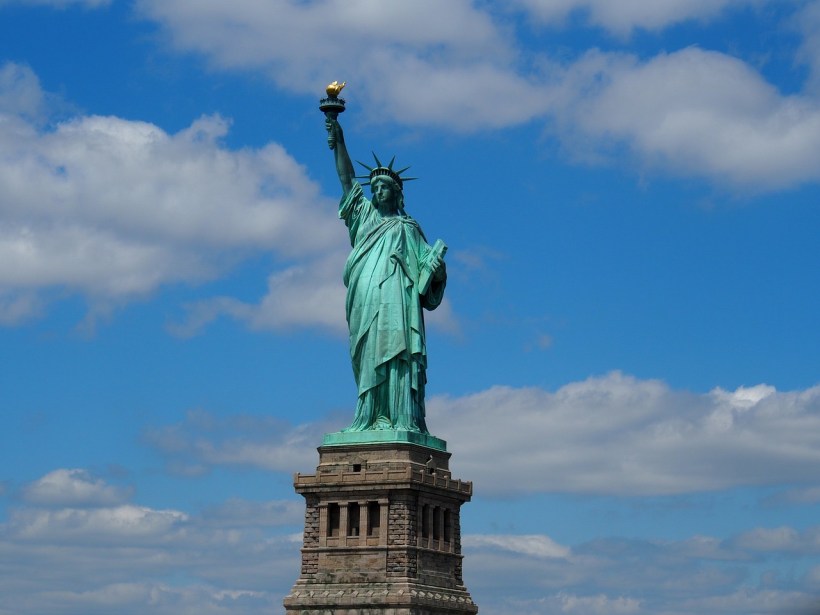
The last half of the 19th century led to industrialization and wage increases in America. Immigration rose and the French gave us Lady Liberty, made of copper. On her island there is a poem, by Emma Lazarus, that ends with these words:
Give me your tired, your poor,Your huddled masses yearning to breathe free,The wretched refuse of your teeming shore.Send these, the homeless, tempest-tost to me,I lift my lamp beside the golden door!”
We will move on to Europe for an overview and get back to America later.
We built ancient societies in China, India, Egypt, Persia and through the steppes of Mongolia. But in Classical Greece (800 – 200 BCE), Homo sapiens built a mythology of Gods and heroes that led the Athenian society to develop the idea of a Democracy. Athens was a polisor a city. It had about 33,000 Greek foreigners and 100,000 slaves living together with about 100,000 citizens. Of these citizens, all men over the age of 18, about 30,000, were voting members of the government. The people were the demos and they had the kratia or the power. It was a government of the people and ruled by the people. In my opinion, Democracy has been the best government Homo sapiens has ever created.
By 500 BCE, the Ancient Greeks knew that the Earth was a sphere. In 296 BCE, Eratosthenes calculated the circumference of the Earth to be about 250,000 stadia. Eratosthenes’ circumference was between 24,000 miles and 29,000 miles. The Earth is, now known, to measure about 24,900 miles around the equator, slightly less around the poles.
Much has been written through out the centuries about the wars that were fought by the Ancient Greeks. Homer, a minstrel poet, born between 1200 BCE and 800 BCE wrote “the Iliad” and the “the Odyssey”. This written work came about 700 years after the war with Troy. In all those years, the tales was told by minstrel singers. These works have been read by generations of Homo sapiens, all around the world. Should you read them? I would say: “Yes!” But it’s your call ……. So it goes.
Persia, an ancient society that was led by a strong man, had problems with ancient Athens. You can read all about these wars with Persia, but the final sea battle, in 480 BC, occurred in the waters between Salamis and the mainland just to the west of Athens.
Overcoming superior numbers with daring tactics and sheer determination, the allied Greek forces won a freedom that allowed for artistic and cultural endeavor which would form the foundations of Western culture for millennia. Xerxes, the leader of the Persian empire, was camped on the shore. He watched the Athenian led ships route his fleet and then, he left and went back to Persia. The Strong Man government was unable to defeat the democracy.
Strong Men
The world has been full of other kinds of governments. There have been religious governments that fought tooth and nail against other religious governments. They physically tortured other people who held a different religious opinion. This still goes on in our world in 2020. Think about the Middle East. There have been Aristocratic governments, where there were Princes and Dukes and Kings. Princes fought against other Princes and Kings fought against other Kings. In the end, common people died in great numbers.
In all of these governments, STRONG MEN ruled the world around them. Aristocratic and religious governments evolved into nations and empires. The history of building nations and empires is complex and local. You are invited to examine it, at will. Today, much of the world is ruled by strong men, even when they call themselves “democracies”. You can spend as much time as you like, looking up how all that happened, but I will move on to tell you more about what happened in the United States and Europe in the hundred years before 1938.
Home is thought of as safe and not home can be full of dragons. For a number of Homo sapiens, home canbe terrifying, but for most humans, not home is … scary.
You have to understand the world, it’s cultures and human history, to stand on the line between home and not home.
Here is an awful truth: Human children are abused by people from within the “Circle of Trust.”Andrew Vachss, has had a great deal of experience with child abusers, and created that phrase. Hey published a CD called Safe Home.
Vachss: “The biggest threat to children is always inside their houses. The predator with the ski-mask who grabs the kid out of a van, while a real thing, is a tiny percentage of those who prey upon children. Most victimization of children is within the Circle of Trust.”
Vachss has written a series of fictional books about Burke and a small group, who fight child abusers. From reading that series, I learned: that one trick child is born for every twelve, who see the light of day. I found that astounding.
Vachss argues that calling children who live through abuse “survivors“ is not clear enough. They may have survived and gone on to abusing children and others make a choice not to abuse children.
Vachss:
“To me, such people are our greatest heroes. They represent the hope of our species, living proof that there is nothing biogenetic about child abuse. I call them “transcenders”.”
The intelligibleUniverse we live in, was formed 13.7 billion years ago. It was developed in a process we call, “the Big Bang”. A singularity exploded (that’s a guess because quantum mechanics can’t work in a singularity) to create energy, atoms, mass, light, Time and Space.
To get a visual understanding of this process, pay attention to the TIME after the Big Bang when each Epoch occurred.
THE BIG BANG THEORY – AN ILLUSTRATED TIMELINE
For 350,000 thousand years after the Big Bang, there was no light emitted, because their was too much energy for photons to escape.
This Universe we live in has gravity bending the time and space. The Universe seems to be expanding and the expansion seems to be increasing at the edge of the intelligible Universe..
This leads astrophysicists to believe that there is dark matter and dark energy in the universe, helping the rate 0f expansion to increase at the edge of the observable Universe.
There are billions of dollars invested in laboritories looking for information in the Cosmic Background Data and the XRAYRadiation data that can help us solve whether Dark Matter and Dark Energy exist.
The STANDARD IDEA is that so much DARK ENERGY exists, that it is 70% of the Universe; and so much DARK MATTER exists, that it forms 25% of the Universe and NORMAL MATTER is only 5% of the Universe, but we can’t SEE it.
There are some astrophysicists, who do not accept the requirements to look for and find: DE and DM. They believe Newtonian physics should be adjusted for accelerations at large radiuses, as Planck did, when he introduced quantum mechanics and as Einstein did, when he introduced his Theory of Relativity. Personally, I side with this group of physicists.
This group propose a Modification to Newtonian Dynamics, MOND. This proposes an insertion of:
α0 = (speed of light) squared /by the radius of the Universe.
You can read about this MOND at NAUTILIS/ cosmos.
That the Universe is intelligible is a problem that can not be easily explained. Some people reach out to God and others simply can’t explain it.
But, if we study the philosophy of the Ancient Greeks, we will discover that the pre Socratic philosophers believed that the world was reasonable and open to study, by reasonable minds.
Too often, the development of rational scientific discovery has been stymied by religious ideas that would not accept rational discoveries.
We have created the LIGO.
Through the use of this Laser Interferometer Gravitational-Wave instrument we have heard the sounds of gravity in action.
Where do we live in the Universe?
We live in a spiral arm of the Milky Way Galaxy.
How many galaxies exist in our Universe?
The Milky Way is one of over a billion galaxies.
How old is the Milky Way Galaxy?
It is about 13.5 BYA. It developed shortly after the Big Bang.
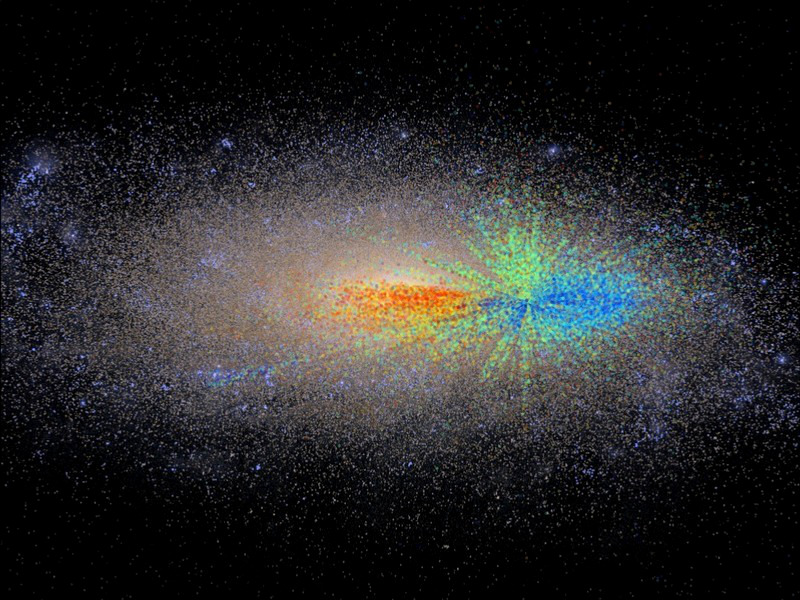
An image across 50,000 light years of of the Milky Way
Shows:
— the earliest stars in our galaxy colored in red and
— stars formed later colored in blue.
The Solar System
Eight planets travel around our Sun, one star of a hundred thousand millionstars in our galaxy. (7)
When was our Solar System born?
We estimate the Solar System to be 4.67 Billion years old. It formed from the solar nebular, from an exploded earlier star, that spun out to a huge disk. This nebula lasted about 2 million years, and it’s center formed into our Sun and the planets formed around it.
Planet EARTH
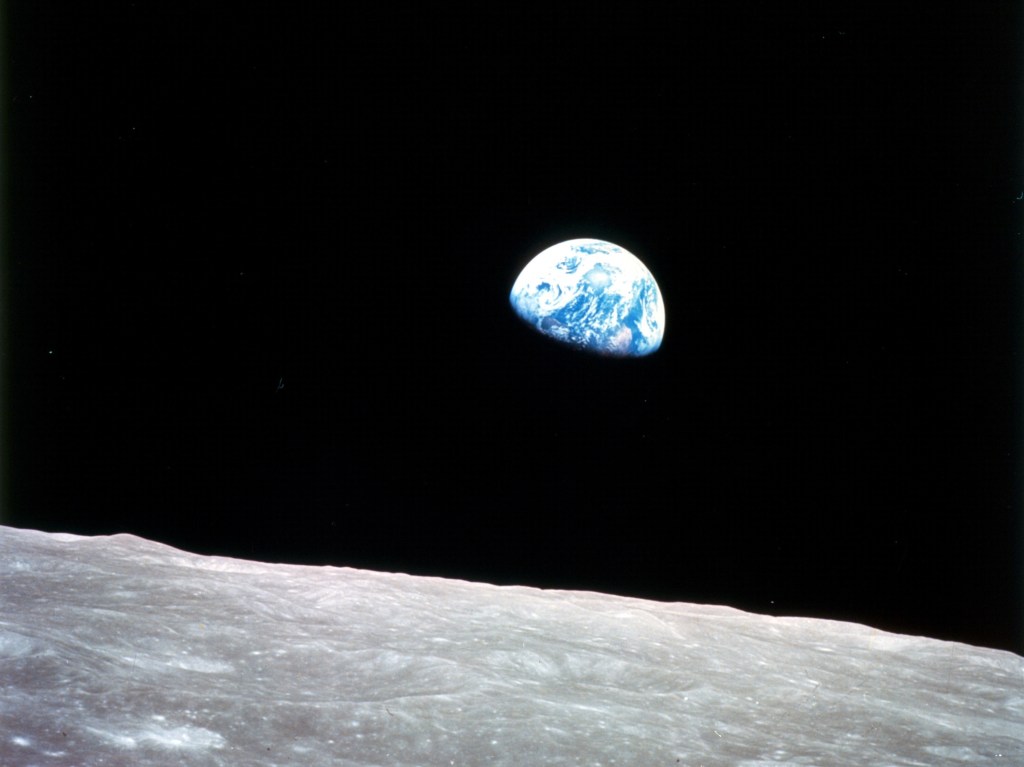
This is the first image of our Earth. It is called “Earthrise”. It was taken on the Apollo 8 mission, that circled the Moon ten times. This was taken on the 24th of December, 1968.
Age of the Earth
We estimate the Earth formed by 4.5 BYA.
So, we have eight planets circling our sun and we have physics and chemistry.