24 October 1965

C-130 37835 was one of the C-130s we had at McGuire. This plane was used to fly to a remote airport in th US. A tower operator there knew that this would be the first four engine airplane that would land at this field. He set up his 8 millimeter motion picture camera to capture this landing. Here is that video:

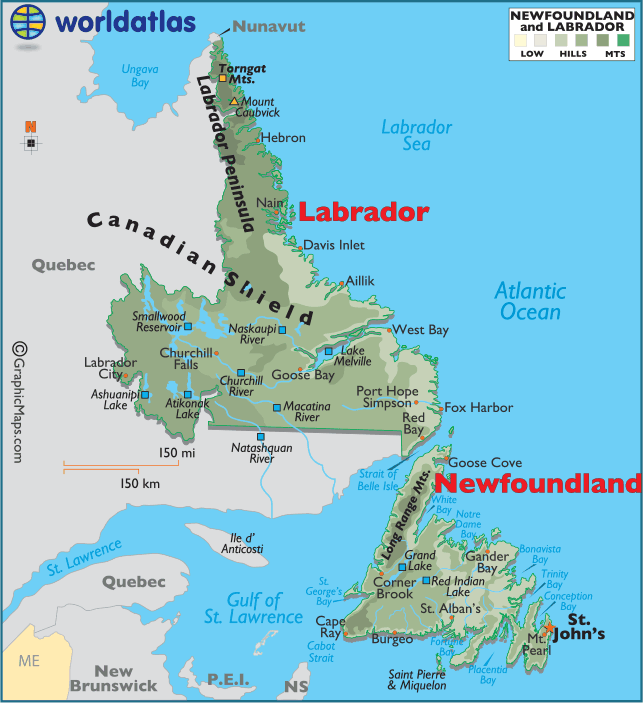
Well, just after I became an Aircraft Commander, I was sent out on a trip to Europe. The aircraft I got was 37835 and after the accident it had, it had no wing tanks. I had to fly to Goose Bay, Labrador to get enough fuel to fly to Prestwick, Scotland.

On the 24th of October Goose had had a lot of snow that had been removed and piled on both sides of the runway. I was getting a Ground Controlled Approach (GCA) from the radar operator at Goose.

The strictest Check Pilot we had in VR-3 was Lieutenant Commander Norman Garsoe. It happened that Norm wanted to go to Rota, Spain because he was being re-assigned there and he wanted to see the housing that was available. Sure enough, he came on my first trip as an Aircraft Commander. In fact, as I was making this GCA he was looking over my shoulder. At about 300 feet above the ground, with large piles of snow on both sides of the runway, Norm said: “Tell me all the electrical components that are on the Battery Bus.”

I turned my head for a second to look at him and then it got to me that he was having some fun. I had to chuckle.

We ended this days flying in Chateauroux and went to the Swans for dinner.

23 September 1965

VR-3 wanted to have me check out as a C-130 Aircraft Commander but they did not want to have the Airlift Wing give them any grief. They arranged for the wing check airman, Commander Tufo, to give me the check ride and we left McGuire on September 23rd.

We went to Chateauroux, France and rested overnight. Check it out: http://www.chateaurouxairstation.com.

The next day we took off and headed east. Our destination was Topel. A Turkish Base where American soldiers were temporarily stationed. As we passed Athens, on our way into Turkey, they told us that the ceiling at Topel was 700 feet. It was still a bit of a flight to Topel and I said I would proceed and decide what to do when I got there.

Well, when we got up there, we spoke to planes coming out. They had stayed there overnight and they said the ceiling was 700 feet. If you look at this map you will find Yalova. That is a very small airport and I landed there several times. It had a radio navigational facility, an ADF Radio. When you wanted to make an approach to this field you could maneuver on the facility and lower yourself to 1100 feet. If you could SEE the runway from there, you could land.

Well, at 1100 feet, we would still be in the clouds. I briefed my crew. I said I would cross the ADF at 1100 feet. Then, I would fly north until we had water underneath us and I would lower myself to 500 feet. I would turn east to fly to Topelo. I said we would fly to the east end of the Sea of Marmara, cross the shore and look for the field. If we saw it, we would land and if we did not see it in three minutes after we reached the shore, we would execute a missed approach and return to Athens.

Well, that’s what we did. We saw the field, we landed, we picked up the troops and we left. I offered the check captain the leg back to Chateauroux and he said: “I’ll tell you when I want the leg.”

My copilot, Pete Simola, got really sick in Chateauroux, so I had the check pilot act as my copilot. We flew back to the States. We landed in Lages in the Azores and then went to Pope, to drop off the troops. Finally we went to McGuire. I never offered him a leg and he didn’t ask for a leg.

When we got to McGuire, he never said anything to me. It was late in the evening. My copilot and I went to the parking lot, he got in his car. It was a fancy Chevrolet that had a manual five speed transmission. He started yelling: “They’ve stolen my transmission.” So, I drove him home.

The next day, the Operations Officer called me and asked if I was qualified as an Aircraft Commander. I said: “I have no idea.” He said: “What happened.” I started to explain and he said: “Just come to my office.” So, I went into his office and explained what had happened. They called the Wing to find out what Commander Tufo had decided. They told us a letter was coming over to explain it.

Well, when the letter came the Commander opened it and read it. When they trained me as a pilot, they told me to do what I thought was the correct thing to do. That is what I did on the check ride. The Check Pilot praised me for having used the Navigation radio and adjusting the decent over water to 500 feet to enable completing the mission. He said he was pleased to elevate me to Aircraft Commander and hoped all the NEW pilots would do as well when they got checked. So, I was an Aircraft Commander.

November 22, 1963

I was in training at Sewart AFB in Nashville, Tennessee to be a pilot on the C-130 Hercules aircraft. We went flying in the morning and when we landed, we learned that President Kennedy was shot to death in Dallas, Texas. This assassination started a heartbreaking series of events that changed the direction of American politics to the right.

John F. Kennedy gave the following instructions to Defense Secretary Robert McNamara and General Maxwell Taylor, the Chairman of the Joint Chief of Staff, regarding the purpose of their mission to Vietnam:

“I am asking you to go because of my desire to have the best possible on-the-spot appraisal of the military and paramilitary effort to defeat the Viet Cong. . . . The events in South Vietnam since May have now raised serious questions both about the present prospects for success against the Viet Cong and still more about the future effectiveness of this effort unless there can be important political improvement in the country. It is in this context that I now need your appraisal of the situation. If the prognosis in your judgment is not hopeful, I would like your views on what action must be taken by the South Vietnamese Government and what steps our Government should take to lead the Vietnamese to that action.[1]”

In doing research for this post I discovered the JFK had decided to bring US troops home from Vietnam after McNamara/Taylor reported what was going on.

Look at this:
http://bostonreview.net/us/galbraith-exit-strategy-vietnam

I quote:

A more thorough treatment appeared in 1992, with the publication of John M. Newman’s JFK and Vietnam.1 Until his retirement in 1994 Newman was a major in the U.S. Army, an intelligence officer last stationed at Fort Meade, headquarters of the National Security Agency. As an historian, his specialty is deciphering declassified records—a talent he later applied to the CIA’s long-hidden archives on Lee Harvey Oswald.

Newman’s argument was not a case of “counterfactual historical reasoning,” as Larry Berman described it in an early response.2 It was not about what might have happened had Kennedy lived. Newman’s argument was stronger: Kennedy, he claims, had decided to begin a phased withdrawal from Vietnam, that he had ordered this withdrawal to begin. Here is the chronology, according to Newman:

(1) On October 2, 1963, Kennedy received the report of a mission to Saigon by McNamara and Maxwell Taylor, chairman of the Joint Chiefs of Staff (JCS). The main recommendations, which appear in Section I(B) of the McNamara-Taylor report, were that a phased withdrawal be completed by the end of 1965 and that the “Defense Department should announce in the very near future presently prepared plans to withdraw 1,000 out of 17,000 U.S. military personnel stationed in Vietnam by the end of 1963.” At Kennedy’s instruction, Press Secretary Pierre Salinger made a public announcement that evening of McNamara’s recommended timetable for withdrawal.

(2) On October 5, Kennedy made his formal decision. Newman quotes the minutes of the meeting that day:

The President also said that our decision to remove 1,000 U.S. advisors by December of this year should not be raised formally with Diem. Instead the action should be carried out routinely as part of our general posture of withdrawing people when they are no longer needed. (Emphasis added.)

The passage illustrates two points: (a) that a decision was in fact made on that day, and (b) that despite the earlier announcement of McNamara’s recommendation, the October 5 decision was not a ruse or pressure tactic to win reforms from Diem (as Richard Reeves, among others, has contended3) but a decision to begin withdrawal irrespective of Diem or his reactions.

(3) On October 11, the White House issued NSAM 263, which states:

The President approved the military recommendations contained in section I B (1-3) of the report, but directed that no formal announcement be made of the implementation of plans to withdraw 1,000 U.S. military personnel by the end of 1963.

In other words, the withdrawal recommended by McNamara on October 2 was embraced in secret by Kennedy on October 5 and implemented by his order on October 11, also in secret. Newman argues that the secrecy after October 2 can be explained by a diplomatic reason. Kennedy did not want Diem or anyone else to interpret the withdrawal as part of any pressure tactic (other steps that were pressure tactics had also been approved). There was also a political reason: JFK had not decided whether he could get away with claiming that the withdrawal was a result of progress toward the goal of a self-sufficient South Vietnam.

The alternative would have been to withdraw the troops while acknowledging failure. And this, Newman argues, Kennedy was prepared to do if it became necessary. He saw no reason, however, to take this step before it became necessary. If the troops could be pulled while the South Vietnamese were still standing, so much the better.4 But from October 11 onward the CIA’s reporting changed drastically. Official optimism was replaced by a searching and comparatively realistic pessimism. Newman believes this pessimism, which involved rewriting assessments as far back as the previous July, was a response to NSAM 263. It represented an effort by the CIA to undermine the ostensible rationale of withdrawal with success, and therefore to obstruct implementation of the plan for withdrawal. Kennedy, needless to say, did not share his full reasoning with the CIA.

So,; Kennedy made the decision on October 11th 1963 to pull our troops out. I knew that sadness fell on America after that assassination but I did not know that Kennedy died: so the military, industrial, congressional complex could make the money they made, in the next 60 years.
ΠΚΑ … 1958

ΠΚΑ is a fraternity that got started in Virginia. The PIKE “A” chapter was founded in 1868 at the University of Virginia. Pi Kappa Alpha limited its membership to white men. This restriction was becoming a problem to a national fraternity in the light of civil rights concerns at American universities. In 1958, at the Rensselaer Polytechnic Institute (RPI) ΠΚΑ “GT” house, the members sent me and Bob Schulz to the ΠΚΑ national convention in Washington, DC, to overturn this restriction.

  We put forward a motion on the issue of ΠKA banning black men as members. Τhe leaders of the meeting called for a vote and rolled out some oldies, …. some 80 year old guys, in wheel chairs, to vote against our motion. Our chapter was GT and these guys came from single letter chapters from all across the south.  In 1964, ΠΚΑ changed the rules that Universities were starting to look at, for allowing fraternities on campus.

But it was instructive to watch that vote, for me. I knew almost nothing about slavery and the loss of the Civil War in the South. As the son of immigrants, raised in New York and having been schooled in the segregated schools of NY, I did not have it in my brain. You see, I lived at 37- 24 102nd Street and 37th Avenue was the dividing line between white and black families. But all the white kids on 102nd street played hand ball and stick ball with the black kids on 102nd street, all the time. We went to the Worlds Fair grounds, out on Flushing Bay, together and played basket ball and touch football. It never entered my mind, that they went to schools on Northern Boulevard and we went to schools on Roosevelt Avenue.

Now, thinking about it, I wonder why I never thought about it. But, you see, racism was not in my brain either. You know, Louis Armstrong lived on 107th Street, just a few blocks from my house and we sometimes rode over there on our bikes, to hear music from his back yard.

But my real education on this subject, occurred when I went through single engine jet training, on the T2J aircraft, at Meridian, Mississippi. I was a Lieutenant Junior Grade when I got there, after my time on the USS Engage. A Black 1st Lieutenant Marine Corps officer came to Meridian, just a few days after my arrival. He had grown up in Chicago and had gone to Notre Dame. Well, we two northern kids went out to eat in Meridian. This was in 1962, a year before the FBI came down to the Sip.

Of course, we could not eat in a restaurant but ended up eating in the black section of the Trailways bus stop. And when we tried to go to the movies, they wanted him to sit up in the balcony.

The next day, he went in to the CO of the Naval Air Station and got transferred to Whiting Field in Florida, to fly the T28s. He just did not want to put up with that bull in Mississippi.

I saw that same stuff, in Johannesburg, South Africa, when I first flew there, in Pan Am 707s, in 1968. Being black, makes people carry an extra burden through this thing we call life. 

August 4th 1964 VIETNAM

On August 4th 1964, I was at home in Country Lakes, NJ and was on alert status as a co-pilot, of a C-130E aircraft crew. I listened to President Lyndon Baines Johnson speak on TV just before midnight about the ship confrontations in the Tonkin Gulf, of North Vietnam. I had been there, on my ocean going minesweeper, MSO USS ENGAGE 433. We had ships run in on us when I was there in 1961. But that did not matter now, I went into my bedroom and packed a bag for the trip that was about to start, because President Johnson said war maneuvers would begin.

We were called out and we left before dawn on August 5th from McGuire AFB and we flew to Shaw AFB, in South Carolina. We picked up a field hospital and headed west. We went to Travis AFB, in California and then to Hickham Field, in Honolulu, Hawaii. From there we continued to Wake Island. By the time we got to Wake Island, we ran into a problem with the oxygen tank that held crew oxygen which we might need in a loss of pressurization. So, we had to wait for parts to get to us. We arrived in Wake on August 8th after crossing the dateline and we were there on August 9th. So, here we were on Wake Island looking at the field from our bunkhouse and seeing a parade of US aircraft landing and taking off every few minutes. It was a very real show of how much force gets moving once war plans are executed and we saw it with our own eyes.

On August 10th, we flew to Kadena AFB on Okinawa, removed the field hospital and then flew to Midway Island, the western most island in the Hawaii chain. I had been to Midway on the Engage. As we were steaming into Midway, there appeared to be a ship in the channel. Captain Zook asked the Operations Officer how much speed it was making and was if it going into port or coming out of port. Ensign Stephen Phelps Henderson III answered: “Making 5 knots and steaming out of port, sir.” But when we got there, it was and old wreck, fast aground to the right of the channel.

Midway is a place where the Albatross gather in large numbers and it is instructive to watch them land and tumble to a stop and to see how they take off from the ground. They are beautiful in flight but they are strange to see on the ground.

The albatross are all over the island. This photo was taken by someone who lived on Midway for several years. it is an albino albatross.

From Midway, we flew to Hickham AFB in Honolulu and to Travis AFB in California and then back to McGuire. That was the first, of many flights that I took to the western Pacific, in my flying for VR-3, Naval Aviation Transport Squadron 3.

SFO 1967

When I joined Pan Am on February 13, 1967, I agreed to became a flight engineer because I was an Instructor Pilot and very experienced international Aircraft Commander in VR-3 and they paid flight engineers more money than co-pilots. Pan Am decided to send me to train in SFO. I went out there with my wife Joann and my daughter Alexis. We lived in Sausalito and I drove to the airport everyday.

Met a guy out there named Ray Anderson. Ray had gone to SFO State with Dan Stanland and Dan became a Navy pilot and we both served in VR-3. Dan was probably the smartest person I ever met and he was my friend. He flew a twin Beech full of top level grass from Mexico to the Utah deserts while he was a Pan Am pilot. He had some top level help from veterans.

When I got out of the Navy in December of 1966, Pan Am said they were going to send me to SFO for my training. Dan told me to look up his old friend Ray. Ray was a collector of records and had a massive collection in 1967 when I was out there. In June of that year, Bill Graham started to have a show every night in the Filmore and I helped Ray set up his projectors. We were in the balcony and Ray put on his light show: The Holy See.

The orchestra was empty and they had punch with acid and punch without acid on the stage. In 1967 acid was a legal substance. The Hell’s Angels did the security. Ray had a son named Randy. He was about 10 and by the time the music got to rocking, he would go to sleep under the tables holding the projectors. Having recently gotten out of the Navy, carrying kids to Vietnam and bodies back home in the C 130, I thought Randy could go to sleep in a fire fight.

I was at the Filmore for Janus Joplin with Big Brother and the Holding company and Jefferson Airplane with Grace Slick singing White Rabbit. That was a hell of a way to get through Pan Am training. San Francisco in 1967 was the place where kids came with flowers in their hair and I did my first hit of Owsley Sunshine.

https://sfist.com/2016/10/20/ray_anderson_avid_record_collector/